
OLIVIA – An Excellent Chat Mode for HF
INTRODUCTION
During road trips, I can still recall from childhood memories, my parents offering me money if I could be quiet for 5 minutes. I cannot, however, remember one instance in which I was actually able to cash in on the deal – I have always been something of a chatterbox.
Fast forward to 1978 when I got my basic ham license – although I very much enjoyed CW in the beginning, by 1979 I was itching to obtain my advanced ticket so that I could get phone privileges on the HF band. Happily, I passed both theory and CW exams – driven primarily by a strong desire to get behind the mic!
There has been a sea of change in amateur radio since those days and I was quick to embrace the digital age. I dabbled for a while with packet (remember the PK232?) both FEC and ARQ and later, after retirement, I enjoyed the delights of FT-8 and, in particular, being able to work the world with low power and a compromise antenna from a downtown condo.
Regardless, I still missed the ability to ‘chat’ and it wasn’t until the COVID pandemic that I had the opportunity to roll up my sleeves and delve into a variety of relatively new transmission modes that were just beginning to garner interest. These included BPSK, Contestia, Domino, Thor and Olivia, all of which are chat modes. BPSK I found to be somewhat dissatisfying since it has minimal error correction compared with the others and after conducting on-air experiments, I concluded that Olivia suited my needs perfectly.
WHAT IS OLIVIA?
In essence, Olivia is a multiple frequency shift keying (MFSK) protocol developed by Pawel Jalocha primarily for HF transmission since it offers excellent error correction features, making it robust even under challenging propagation conditions.
Olivia features two layers of error correction, the lower of which is a basic forward error correction (FEC) algorithm common to most MFSK systems. The higher level is a secondary FEC layer based on Walsh Functions in which orthogonal spreading provides interference rejection and far superior signal recovery.
Although these combined layers sacrifice transmission speed for data accuracy, the overall performance is truly amazing. Olivia works even when the received signal strength falls 10 – 14dB below the noise floor. During a few QSOs on Olivia I lost all visible trace of the incoming signal on the waterfall, and neither was I able to hear it above the noise level yet the copy was still 100%!
Olivia comes in a variety of different ‘flavours’ based on the number of ‘tones’ used in the transmission. The lower the number of tones, the faster the transmission speed and conversely the higher the number of tones, the lower the speed – HOWEVER, more tones equate with improved data accuracy, hence increased ‘robustness’ in poor propagation conditions. The most common ‘flavours’ (although there are many others) are summarized below where the numbers prior to the forward slash indicate the number of tones and those after the slash denote the bandwidth in Hz.
4/125, 8/250, 16/500, 32/1000, 64,2000
My preferences are 8/250 and 16/500, the latter being the best compromise for overall performance vs. taking up too much valuable bandwidth!
The following link includes further details in addition to images of the signal characteristics of Olivia on the waterfall. https://www.sigidwiki.com/wiki/Olivia
WHERE TO FIND OLIVIA
The table below indicates recommended calling frequencies for Olivia operation. Note however, that other digital modes mentioned in this discussion will frequently be found on or around the same frequencies, so a good eye on the waterfall and a good ear (each mode has its own distinctive sound) will be needed to distinguish between them.
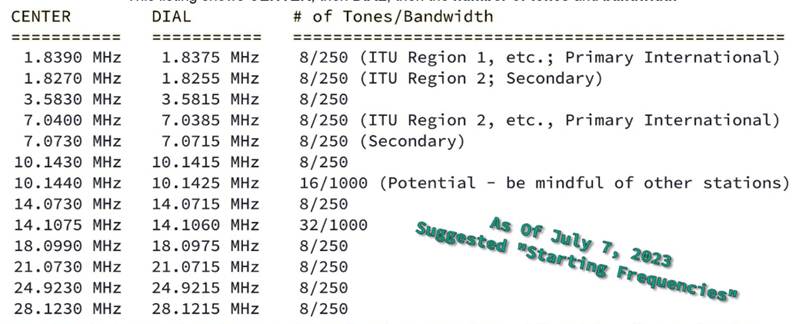
I strongly recommend starting on 14.0715 as that is where most of the activity seems to be centered. (I have seldom heard digital signals other than FT-8 on 18, 15 or 12m.)
THE DEVIL’S IN THE DETAIL
I confess to finding the technical discussions of Olivia, especially the mathematical details of the error correction algorithms mind boggling so haven’t attempted to mention them here.
For those with sharper minds, the following video offers more detailed discussion and also provides some excellent operating tips. https://www.youtube.com/watch?v=kds4RCQQ8a0
IN SUMMARY
For those who may be looking for a keyboard to keyboard digital ‘chat’ mode, Olivia provides an excellent opportunity. Running approximately 25 watts into 15m delta loop, I have had several QSOs with Japanese stations and many more with amateur operators in Canada and the U.S. ‘Regulars’ often appear on 20m and it is always fun to check in with old friends.
Some additional links are provided below:
https://en.wikipedia.org/wiki/Olivia_MFSK
https://www.w1hkj.org/modes/olivia.htm
73 VA7AMV
Rolf Hopkinson
2026-01-13
Interesting Rolf. I had a look into it and will give it a go. Hopefully catch you on the air sometime!