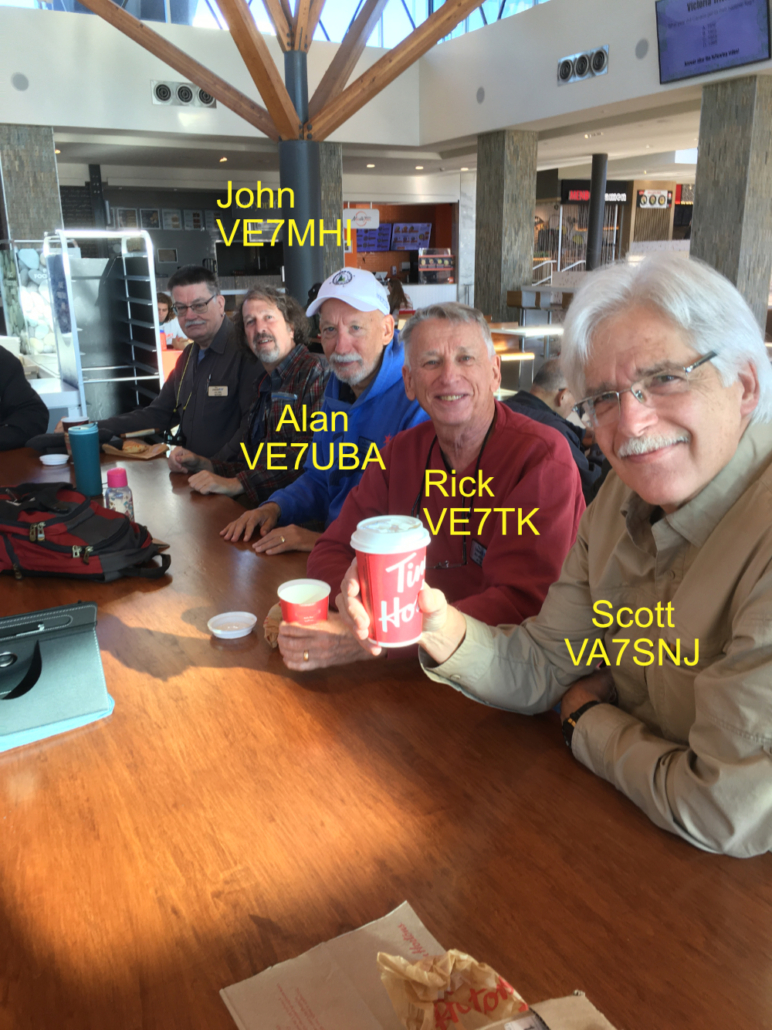
Coffee Shack – July 14th

IslandHF’s monthly Coffee Shack continues to be a favorite activity for its members. The July 14th edition saw nine members sit down for some animated and cheery conversations.

Dan Wilson VE7VNA brought along a older antenna tuner which he hopes to integrate into this “shack”. Pierre VE7AL brought along a venerable Kenwood TS-140S which he sold to Dan. Interesting goings-on happening at the “Shack”.

Dan was really busy because he also met with Alan Mallet VE7AWM who dropped by. Alan was greeted by all members around the table.

Drop by for next month’s Coffee Shack – August 11th.

2025 Field Day feedback

I agree that field day for us was a success. Good companionship, fine weather, and a beautiful location although a few more QSOs would have been the icing on the cake

Roger has written about the two antenna types below so the only additions I would make is that verticals with radials on the ground (the Chameleon) are inherently inefficient because of ground losses. Add in matching transformer losses and much precious power has gone to waste.

Alan’s POTA antenna should be better because the radials are elevated and there are no matching transformers to confuse the situation. Note that the link provided by Roger refers to tuned radials. Were Alan’s radials tuned? Without measuring the current in each radial we do not know. The link also refers to placement of the radials to obtain directivity. The EZNEC plots shown in the link are impressive, but the real world situation can be quite different with trees and bushes in the way.

Those of us at last year’s IHF field day will recall that the CW station using the vertical had a hard time making QSOs and I think we were running 100W. I will add that the antenna was not in the greatest of locations

What do we do for next year? I have always favoured doublet/dipole antennas even in an inverted V configuration and would suggest we consider this for next year.

Now to get set-up for the Canada Day contest starting tomorrow!

73 Brian VE7JKZ

2025 IslandHF Field Day Post Mortem

Despite our remarkably modest score, I think that IHF can declare that the FD event was a success for us!  What can be better than playing with radios in the sunshine? 

The concept of a QRP station running on batteries certainly simplifies the logistics, but we were definitely at a disadvantage to other entries that were running 100 – 1500 watts! Because of our low power signal, sending CQ on CW brought few responses; over 95% of our CW QSO’s were a result of “search & pounce” operations where our weak signal was less of a handicap.

Alan’s antenna was his version of a design that is commonly known as the “POTA Performer”, which relies on a resonant vertical whip and resonant elevated radials.  When adjusted properly (using Alan’s built-in tape measures), this antenna provides a good match to 50 ohms without the use of an antenna tuner.  Here is info on the original design: https://whiteriverradio.com/wp-content/uploads/2023/07/POTA-PERformer-Antenna-by-KJ6ER-2023-03-1-1.pdf

Andy was using a broadband antenna made by Chameleon.  The secret is in the “magic” white module at the bottom (it looks like a loading coil, but isn’t) that they call the “Hybrid”.  The hybrid is actually a uniquely designed step-up transformer that works with the radiating element (either an extendable whip or the end-fed wire) to provide an acceptable (but not perfect) match on most of the ham bands.  It is actually possible to use this antenna without a tuner, but we were using tuners on both radios to ensure a good match.   Brian and I both expressed a small degree of skepticism about the inner workings of the Hybrid, as we both believe that it introduces loss as part of it’s broadband matching function.   Very little has been published about the Hybrid’s design, but about a year ago I saw an article written by a VK ham who had very carefully taken one apart, traced the schematic, and performed some loss measurements.  As I recall, the losses were typically 3 dB or higher.

Thinking about next year, we might want to use the same QTH again.  It had nearby washrooms and food, was easy to get to (for three of us) and was close to the water.  It might be nice to have more power, but battery operation worked well this time!  The bandpass filters worked fine, and we had no problems with cross-band interference or front-end overload.

Knocking off at 4 pm or earlier is ideal.

73,  Roger